
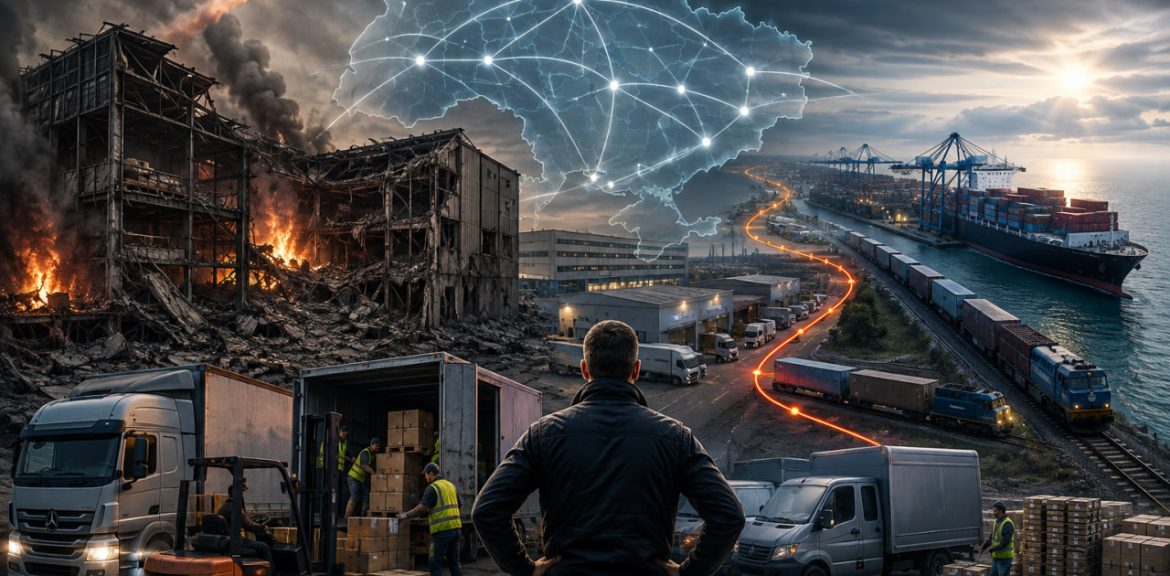

The night of August 4 to 5, 2026 became one of the heaviest blows to Ukraine’s civilian logistics infrastructure since the start of the full-scale war. People died. Hundreds of thousands of square meters of warehouses were destroyed. But behind these numbers lies something bigger than a single tragedy: a systemic shift that is already underway and that businesses will have to understand and accept.
This article is not about the tragedy. It is about what comes next.
The Scale of Losses: What Exactly Was Destroyed
Since the beginning of July 2026, Russia has been methodically destroying Ukraine’s logistics infrastructure. These are not isolated hits, this is a targeted campaign against civilian supply chains.
In a single night, from August 4 to 5, retail and distribution losses turned out to be unprecedented. Fires broke out at four distribution centers of Fozzy Group at once, centers that supplied the Silpo, Fora, and Thrash chains. Six employees died: three did not make it to shelter when the strike coincided with an air raid alert, another three were killed at a railway station on their way home. The company officially warned customers about supply delays, with cold storage capacity for fresh categories hit especially hard, so shortages of dairy, meat, vegetables, and eggs are already visible on shelves.
The Novus chain suffered several direct hits on its single logistics center covering 40,000 square meters. Opened in January 2024 with EBRD financing, this center served all 173 stores of the chain. It has been shut down completely. Rozetka’s largest warehouse in Brovary was destroyed beyond repair, the third attack on it in a week. Epicentr saw two large warehouse complexes damaged, along with the Epicentr Ceramic Corporation plant.
Logistics operators suffered no less. Nova Poshta’s sorting center in Kyiv was destroyed, three people died. Raben Ukraine’s terminal in Brovary came under fire. A class A automated complex covering 20,000 square meters, Denka Logistics (MTI Group) in Chaiky, the main logistics hub for Intertop, Pandora, and Samsung Experience Store, was put out of operation. One of the largest logistics complexes near Kyiv, Amtel, covering 100,000 square meters, burned down together with WineTime and Goodwine products. Another 65,000 square meters were lost at the RLC site. Operators using these complexes included Ekol Logistics, DB Schenker, and Logistics Plus.
The Strike on Manufacturers
The attack hit not only retailers’ warehouses but also the distribution facilities of manufacturers themselves. Warehouses belonging to Danone, Lactalis, and the Yahotyn Baby Food Dairy Plant were damaged. This is a critically important point: the supply problem cannot be solved simply by switching to direct deliveries, because part of the chain has already been destroyed at the manufacturer level.
In total, more than 400,000 square meters of Ukraine’s warehouse infrastructure have been destroyed since the start of July 2026.
The Market’s First Response
Novus CEO Marko Petkevič described the chain’s first steps immediately after the strike: key suppliers were switched to a direct-delivery format straight to stores, bypassing the central warehouse; backup storage sites were activated in parallel, and product flows were redirected through regional hubs.
This is an anti-crisis plan working in real time right now. And what Novus is doing under pressure of circumstances is something other market players should be planning for in advance.
Why the Centralized Model Has Run Its Course
Centralized logistics, one large distribution center near Kyiv serving the entire chain, was a perfectly rational model. It delivered economies of scale, simplified inventory management, and lowered operating costs. Novus opened its single logistics center in January 2024: 40,000 square meters, state-of-the-art equipment, the heart of supply for 173 stores. One strike, and the heart stopped.
The problem is not that companies built poorly. The problem is that a model optimized for efficiency in peacetime turns out to be maximally vulnerable to a targeted strike. One large facility means one point of failure, and therefore a halt to the entire chain. A business built on a single point of concentration is a business built on a single point of risk.
The market has already recognized this and is restructuring. Some, under pressure, like Novus. Others, in advance, as a strategic decision.
The Route Crisis Around Ukraine
The problem is not limited to the country’s territory. The external logistics infrastructure serving Ukraine is also under pressure.
Odesa. Since July 22, vessels have stopped entering Ukrainian ports. Maersk was the first to announce a suspension and reroute its fleet. June to July 2026 became one of the hardest periods for the Greater Odesa port infrastructure throughout the entire war.
Constanta. The Romanian port is taking in everything that used to go through Odesa, but its infrastructure was not built for such volumes at once. Queues at the Orlivka-Isaccea crossing have become a constant factor: the ferry crossing physically cannot handle the doubled flow.
Poland. The total volume of modern warehouse space in Poland reached 38 million square meters in the second quarter of 2026, yet vacancy in the Warsaw region has already dropped below 5%. A good warehouse near the Ukrainian border is already scarce and expensive. On top of that, there is a factor that statistics do not capture: farmer strikes at the Polish-Ukrainian border. A reliable route can turn into weeks of delays in a single day.
Lithuania and Klaipeda. Klaipeda is the only major Baltic port that showed growth in the first half of 2026: container traffic rose 12%, to 7.2 million tonnes. But growth also means pressure on capacity and prices. Quality modern warehouses exist, but their cost is no longer “Baltic.”
Estonia. The Port of Tallinn (Muuga) is serious infrastructure with capacity for containers, Ro-Ro, and refrigerated cargo. Cargo turnover at Estonian ports declined in the first quarter of 2026, and this is exactly what opens up opportunities for Ukrainian cargo: there is less congestion here than in Poland or Lithuania.
Moldova. The governments of Ukraine and Moldova have agreed on a 50% discount for rail transit of Ukrainian goods through Moldovan territory until the end of 2026. The country’s warehouse capacity is not yet overheated, and the Moldova to Constanta rail corridor already exists and is developing.
Rail. Maersk has already launched a temporary rail service between Constanta and terminals in Ukraine, with T1 clearance included in the tariff. Rail links between Poland, Lithuania, Romania, and Ukraine are fast, predictable, and not dependent on border strikes. For critical categories of goods, this is already the main route.
To see the whole picture at a glance, let’s bring the key external alternatives together in one table.
| Route / Hub | Current Status | Warehouse Capacity | Key Risks and Constraints | Best Suited For |
| Odesa | Ports halted since July 22, fleet rerouted | None | Hardest period of the entire war; the direction is effectively unavailable | Not a working option right now |
| Constanta (Romania) | Absorbing volumes that used to go through Odesa | Limited, operating at the edge | Not built for such volumes; queues at the Orlivka-Isaccea crossing | Sea entry point plus rail corridor into Ukraine |
| Poland | 38 million sq m of warehouses, vacancy below 5% in Warsaw | Scarce and expensive near the border | Farmer strikes at the border, weeks of delays in a single day | Western direction, given a buffer warehouse |
| Lithuania (Klaipeda) | Only Baltic port with growth (+12%, 7.2 million t) | Available, but cost is above average | Pressure on capacity and prices | Baltic direction, containers |
| Estonia (Muuga) | Cargo turnover declined in Q1 2026 | Less congestion, capacity available | Longer transport leg | Containers, Ro-Ro, refrigerated cargo; an underrated reserve |
| Moldova | Corridor developing, 50% discount on rail transit through end of 2026 | Not yet overheated | Young corridor, smaller capacity | Southern direction, linked to Constanta |
New Architecture: The Hybrid Supply Model
The answer to centralized vulnerability is distributed resilience. Not one large hub, but a network of smaller points, where a strike on one does not stop the entire system. In practical terms, this model consists of six elements.
- Decentralization of warehouses inside Ukraine. Smaller regional warehouses instead of one megahub near Kyiv. More expensive to operate, but a strike on one hub does not stop the whole network.
- Buffer stock outside Ukraine. Poland for the western direction, Lithuania and Estonia for the Baltic direction, Moldova for the south. Goods are stored outside the risk zone and pulled into Ukraine through established customs corridors exactly when needed.
- Rail as the primary route. For critical categories, food, pharmaceuticals, FMCG, rail makes it possible to supply directly to regional points without a large central hub.
- Direct “manufacturer to store” deliveries. For part of the assortment, without a single point of failure in the chain. This is exactly what Novus launched as an anti-crisis plan; other players should make it a standard.
There is, however, an important caveat voiced by manufacturers themselves. Arsen Didur, executive director of the Ukrainian Association of Milk Producers, confirmed that direct deliveries to every store are technically impossible for all categories. Since Danone, Lactalis, and the Yahotyn Baby Food Dairy Plant’s distribution facilities were damaged, fresh categories, dairy, meat, vegetables, cannot do without regional hubs. The hybrid model does not mean everyone can switch to direct deliveries: some categories physically require intermediate hubs.
- Cross-docking instead of storage. Warehouses operate as cross-docking sites: goods are not stored for long periods but are quickly routed into retail. Less risk concentration on a single facility.
- Insurance at every level. From manufacturer to shelf, including points of sale, since shopping centers and stores are also under attack. This is no longer optional, it is an operational standard.
The Cost of Resilience
The hybrid model is more expensive than the centralized one. More storage points mean more rental and management costs. More routes mean higher logistics costs. Insurance is a separate line of expenses.
But there is another calculation. A single strike on a centralized center means losses of billions of hryvnias plus empty shelves plus lost customers. The distributed model costs more every day, but it protects against catastrophic losses. This is no longer logistics optimization. It is management of the risk to a business’s very existence.
The Role of the Customs Broker and Logistics Operator in the New Model
In the new hybrid model with buffer warehouses in several countries, customs clearance stops being a purely administrative procedure and becomes a strategic element of the chain. The speed and reliability of clearance at every border determine whether the entire system works.
End-to-end T1 transit. T1 transit under one’s own financial guarantee, from the port of departure to the destination customs office in Ukraine, makes it possible to move cargo without intermediate clearance in transit countries. This saves time and money on every shipment. Daleth Group is an authorized guarantor within NCTS, confirmed in Poland, Lithuania, Estonia, and Romania. One document from Gdansk, Klaipeda, Tallinn, or Constanta, to any customs office in Ukraine.
Urgent clearance. As the supply chain is rebuilt around direct deliveries and small batches, the ability to quickly clear cargo at a road border crossing becomes critical. Vans, small batches, urgent shipments, straight from the wheels to the shelf.
Supply chain design as a service. The most important competency under the new conditions is not performing individual operations, but designing a complete, resilient supply chain: from the source of the product to the customer’s final point, accounting for customs in every transit country, with backup routes and an understanding of where and how to store buffer stock.
Conclusion
Russia is striking at the model. But the model is already changing.
What Novus and Fozzy Group launched as an anti-crisis plan under fire, direct deliveries, regional hubs, distributed logistics, will become the new standard for the entire market.
The question is not whether the model will change. It is already changing. The question is who will build the new architecture first: under the pressure of crisis, or in advance, as a strategic decision.
Those who understand this today will have the advantage tomorrow.