
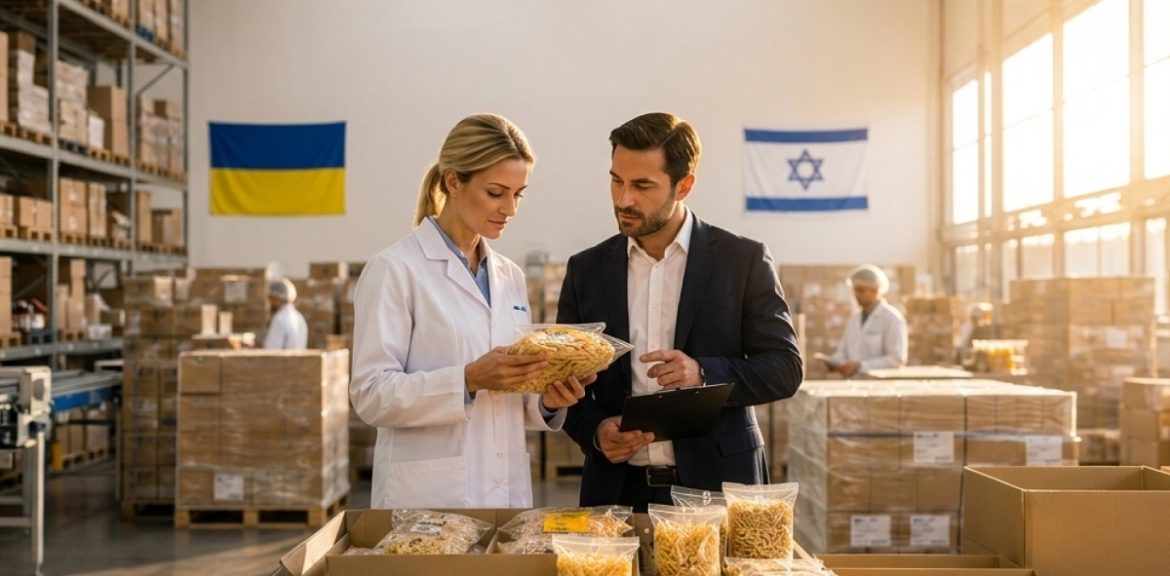
Israeli supermarket chains are looking for new food suppliers, and Ukraine is becoming one of the most actively considered directions. The question of why Ukrainian products are attractive for export has a concrete answer: a combination of price, quality, and a broad assortment that’s hard to find in other regions. In this article, we’ll cover what’s happening in the Israeli market, which product categories are in the highest demand, and how a Ukrainian manufacturer can enter the local retail sector.
Current state of the Israeli food market
The Israeli food market depends on imports due to limited land for domestic agriculture, the cost of local production, the capacity of that production, and the desire to meet the needs of people accustomed to certain food habits. Local chains are constantly looking for suppliers who can offer stable volumes and a competitive price. In recent years, Ukraine has opened dozens of new export directions for food products: ready-made meat products or semi-finished goods, eggs and egg products (including mayonnaise), dairy products, confectionery, semi-finished products, beer, vodka, sunflower oil, sugar, various types of canned goods, and other finished products. This creates the basis for systematic cooperation rather than one-off deliveries.
Why Israeli retail is looking for new suppliers
Israeli supermarket chains are interested in Ukrainian manufacturers for several reasons at once. First, it’s supplier diversification following disruptions in traditional logistics chains. Second, the price of Ukrainian goods remains competitive compared to European equivalents. Third, Ukrainian manufacturers show a willingness to adapt products to local requirements: obtaining kosher certificates, especially for dairy products and canned goods. That’s why the question of why Israeli chains are interested in Ukrainian manufacturers comes up increasingly often at industry trade shows and business forums.
Advantages of Ukrainian manufacturers: price, quality, assortment
Ukrainian food products compete on three levels at once. Price stays below the European average thanks to affordable raw materials and production costs. Quality is proven through years of work with European markets, where Ukrainian manufacturers have been supplying products for several years already. The assortment covers grains, oils, dairy products, honey, confectionery, and ready-made meals. This combination shapes the answer to why Ukrainian products are attractive for export specifically to the Israeli market, not just the European one.
Food product categories with the highest demand in Israel
Not all categories of Ukrainian exports are equally in demand in Israel. The highest demand centers on products that are difficult to produce locally in the required volumes. Here are the food products most frequently exported from Ukraine to Israel:
- grain crops, flour, and cereal products;
- oils and fats, including sunflower oil;
- honey and beekeeping products;
- eggs and egg products;
- animal feed;
- beer, vodka;
- sugar;
- confectionery and snack products.
The categories with the highest demand in Israel are exactly those where Ukrainian manufacturers already have proven experience supplying other markets, including EU countries.
Kosher certification requirements for exporting to Israel
Kosher certification remains one of the main barriers to entering Israeli retail. Without it, products won’t reach the shelves of most major chains, since a large share of shoppers follows kosher dietary standards. Certification is issued by rabbinates or recognized kosher agencies after inspecting the composition, equipment, and production process. The procedure for importing food products into Israel is governed by Israeli food safety legislation, while the quality and safety requirements for the products themselves in Ukraine are set by Ukrainian legislation on the basic principles and requirements for food safety and quality. Whether kosher certification is needed for exporting to Israel depends on the product category: for most processed products, it’s effectively a mandatory condition for entering retail chains. Daleth Group helps manufacturers navigate this process correctly: we understand exactly which certification a specific chain or buyer requires, and we support document preparation to meet those requirements.
Logistics and delivery routes from Ukraine to Israel
Delivering food products requires careful route planning and strict temperature control. The main options include sea freight through Black Sea ports, as well as combined routes through Europe followed by a sea or air leg. The customs clearance procedure for export shipments is defined by the Customs Code of Ukraine, and additional preferences are granted under the free trade agreement between Ukraine and Israel. Which logistics routes are used for delivery to Israel depends on the type of product: perishable goods more often go by air or refrigerated sea transport, while stable raw materials such as grains or oils travel by sea container lines. Well-structured international logistics helps shorten delivery times and preserve product quality along the entire route. It’s also worth considering the reverse direction: delivery from Israel also requires separate logistics planning if a manufacturer works with Israeli raw materials or equipment.
How a Ukrainian manufacturer can enter Israeli retail chains
Entering Israeli retail starts with document preparation and ends with negotiations with chain buyers. First, it’s worth assessing what export requirements apply to a specific product category, including kosher certification and sanitary permits. Next comes finding a local distributor or partner with contacts at supermarket chains. Here’s how Ukrainian manufacturers enter the Israeli market in practice:
- prepare a full package of certificates, including kosher;
- find a local distributor experienced in import;
- adapt packaging and labeling to local requirements;
- take part in relevant food industry trade shows;
- offer a test batch for the chain to assess demand;
- account for the readiness to work with Ukrainian banks;
- account for martial law;
- account for the time it takes to manufacture the goods in Ukraine;
- account for prepayment for the shipment;
- and so on.
The question of how to sell Ukrainian products abroad is answered precisely by consistently working through these steps, not by a single attempt to enter a new market.
Examples of successful partnerships and case studies
Ukrainian manufacturers of grains, oils, and confectionery already have experience supplying markets in the Middle East through direct contracts with distributors. The most successful cases share a common trait: the manufacturer prepared documents in advance and adapted the product to local requirements, rather than trying to enter the market with a ready-made assortment without changes. This approach shortens the time to reach retail shelves and reduces the risk of rejection at the certification stage.
Conclusion
Israeli retail is looking at Ukrainian manufacturers through a combination of price, quality, and willingness to adapt to local requirements, particularly kosher certification. Systematic document preparation, the right choice of logistics route, and partnership with a local distributor open the way to shelves in Israeli chains. But entering a new market is rarely limited to the delivery itself: manufacturers often need a partner who can find the right contacts, help build a business model for a specific market, and calculate the cost of production factoring in logistics and certification. The Daleth Group team handles this entire process end to end: finding partners and obtaining kosher certificates, financing and delivering shipments, resolving prepayment and banking issues, including through EU-based companies that can act as agents and purchase guarantors, as well as full support for export operations from logistics to customs clearance. All these services are available under one roof, so reach out for a consultation before entering a new market.
FAQ
Why are Israeli chains interested in Ukrainian manufacturers?
Chains are looking for supplier diversification, competitive pricing, and manufacturers’ willingness to adapt products to local requirements, including kosher certification.
Which food product categories are most in demand in Israel?
The highest demand is for grains, oils, honey, egg products, animal feed, and confectionery.
Is kosher certification required for exporting to Israel?
Yes, for most processed food products, kosher certification is effectively a mandatory condition for entering retail chains.
Which logistics routes are used for delivery to Israel?
The main options are sea freight through Black Sea ports and combined routes through Europe followed by an air or sea leg.
How can a Ukrainian manufacturer enter Israeli retail?
You need to prepare certificates, find a local distributor, adapt packaging, and offer a test batch for the chain to assess demand.