
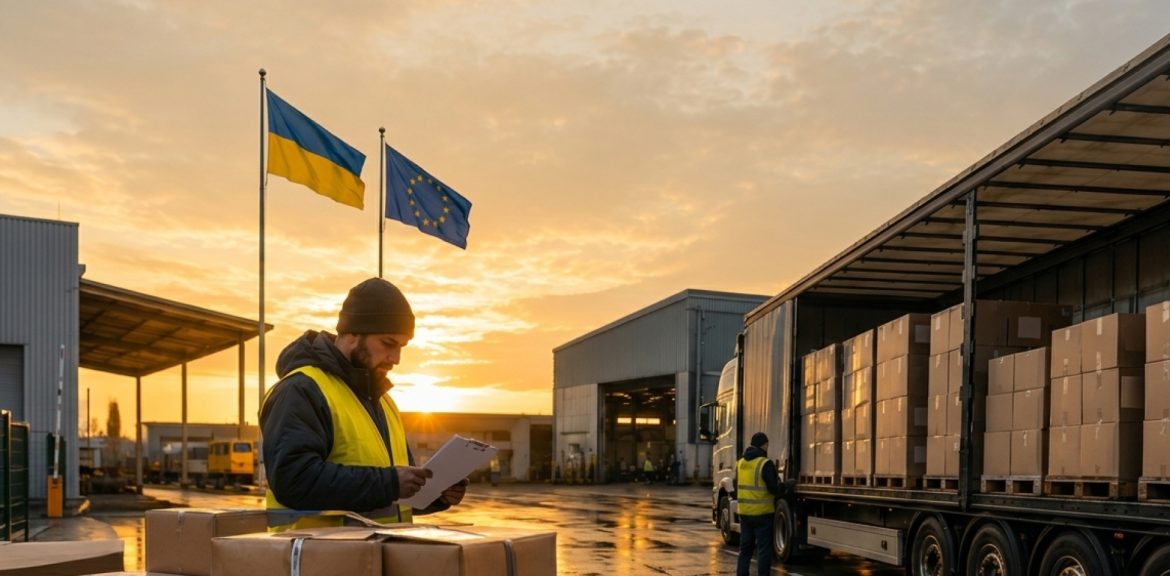
Since the start of the full-scale invasion, the main flow of humanitarian aid has been directed to Ukraine from Poland, Germany, the Czech Republic, Lithuania, Estonia, Great Britain and other countries. Thousands of organisations daily send shipments of food, medicines, generators, clothing and equipment, energy-saving and generating devices, solar panels, car parts, vehicles and more. Yet even humanitarian aid requires proper customs clearance, including the T1 declaration, which is the key document covering the leg of the route from the country of dispatch to the Ukrainian border or the destination customs office in Ukraine. Below is a detailed breakdown of how this works and what to prepare in advance.
What Is T1 for Humanitarian Cargo
T1 is a standard transit customs declaration in the NCTS system, but with a number of important features specific to humanitarian shipments. When importing humanitarian aid into Ukraine, T1 is opened at the customs office of dispatch in the EU and accompanies the cargo to the Ukrainian border.
The humanitarian status of the cargo does not cancel the T1 requirement for transit through the EU – it can only affect the list of required documents and the customs benefits applied in the country of destination. For organisations that regularly send humanitarian aid to Ukraine across the Polish, Slovak, Hungarian or Romanian border, T1 is a mandatory customs control instrument regardless of the non-commercial nature of the shipment.
Daleth Group processes T1 declarations for cargo shipments from Europe to the Ukrainian border under a comprehensive financial guarantee – around the clock, seven days a week.
When T1 Is Required for Humanitarian Cargo
T1 for humanitarian aid heading to Ukraine is required when: the transit cargo is dispatched from an EU country (Poland, Czech Republic, Lithuania, Estonia, Latvia, etc.) and travels in transit through the EU customs territory to the Ukrainian border; humanitarian aid is transported by road or rail through the Polish, Slovak, Hungarian or Romanian border to Ukraine; the cargo moves from an inland warehouse in the EU to a customs office on Ukrainian territory (NCTS procedure from place of dispatch to place of clearance); a humanitarian cargo is transshipped at an EU transit hub and continues onward to Ukraine.
Even if a shipment is marked as «humanitarian aid» and is exempt from duties and VAT on import into Ukraine, the T1 transit procedure is mandatory to control the movement of the cargo until it is closed at the Ukrainian customs office.
Specifics of Humanitarian Cargo to Ukraine
Humanitarian shipments to Ukraine have a number of distinctive characteristics that directly affect the T1 processing procedure.
Varied composition. Humanitarian cargo often contains dozens of different categories of goods – from food products to medical equipment, generators, clothing and communications equipment. Each category may have its own customs code and requirements.
Non-commercial nature. The value of the cargo on the invoice may be zero or nominal (donation / gift), which complicates the determination of customs value for T1 processing.
Special senders. The sender is often a non-commercial organisation, foundation or government body in an EU country, which affects the list of required supporting documents.
Urgency. Humanitarian cargo, especially medicines and food products, has critical delivery deadlines – a border delay caused by an incorrectly processed T1 can have serious consequences.
Control of end use. Customs may require confirmation that the cargo is genuinely intended for humanitarian purposes and will not be sold commercially on the Ukrainian market.
Documents Required for T1 Processing
The document list for T1 processing for humanitarian cargo to Ukraine includes both standard and specific items.
| Document | Required | Notes |
| Commercial invoice / Donor invoice | Mandatory | May contain zero value for donations |
| CMR consignment note or railway waybill | Mandatory | For the relevant mode of transport |
| Packing list | Mandatory | With detailed listing of all items |
| Export customs declaration (country of dispatch) | Mandatory | Issued in the EU country of origin |
| Confirmation letter from the sending organisation | Recommended | Confirms non-commercial nature |
| Humanitarian aid certificate | For some countries | Issued by an authorised body in the EU |
| Phytosanitary / veterinary certificate | Depending on cargo | For food products, plants, etc. |
| Financial guarantee | Mandatory | T1 cannot be opened without a guarantee |
How the T1 Processing Procedure Works
Step 1. Compiling the full document package. The sending organisation in the EU country provides the broker with all available documents: invoice (even with zero value), packing list, confirmation from the recipient in Ukraine. The broker verifies the availability and compliance of documents with requirements.
Step 2. Cargo classification. The broker determines the customs codes (CN) for each category of goods in the humanitarian shipment. This is particularly important for mixed shipments with dozens of items – medical equipment, food products, generators and clothing have different codes and different requirements.
Step 3. Filing T1 in NCTS. The broker enters data into the NCTS system, specifies the route to the Ukrainian border, the means of transport and selects the appropriate financial guarantee. The system generates an MRN number and TAD.
Step 4. Transit under customs supervision. The cargo moves along the route specified in T1. At individual checkpoints physical inspection is possible – especially for cargo with complex or specific composition (medical equipment, generators). Learn more about international cargo delivery for different cargo categories.
Step 5. Closing transit at the Ukrainian customs office. Upon arrival at the Ukrainian border customs office, customs closes T1 in NCTS. The cargo then undergoes customs clearance under the «import» or «humanitarian aid» procedure on the Ukrainian side.
Who Can Process T1 for Humanitarian Cargo
| Party | Can they process T1? | Conditions |
| Customs broker | Yes | Access to NCTS and financial guarantee required |
| Carrier | Yes, conditionally | Authorised consignor status required |
| Sending organisation | Rarely | Only with NCTS authorisation |
| Volunteer organisation without a broker | No | Engagement of authorised person required |
In practice, for the vast majority of humanitarian organisations, engaging a customs broker is the only realistic option. This is especially relevant for NGOs and volunteer foundations sending aid to Ukraine from various EU countries but without their own customs infrastructure.
Daleth Group holds authorisation to process T1 under a comprehensive financial guarantee for shipments from Poland, Estonia, Latvia and Lithuania, as well as for shipments from inland Polish customs offices to the Ukrainian border – without a separate cash deposit for each individual shipment. Read more about customs brokerage services from Daleth Group.
Common Errors in T1 Processing
| Error | Consequences | How to avoid |
| Zero value on invoice without explanation | Customs will request additional documents or refuse to open transit | Include «donation» / «humanitarian aid» and explanation on the invoice |
| Mixed cargo without detailed packing list | T1 processing is impossible or will take critically long | Detail every item line by line |
| Missing certificates for medicines and medical devices | Delay or refusal at customs even for humanitarian cargo | Check the permit list in advance for each category |
| Wrong address or recipient details in Ukraine | Inability to close T1 in NCTS on the Ukrainian side | Verify recipient details before filing |
| Delay in closing transit in Ukraine | Open transit may lead to penalties against the guarantor | Monitor cargo receipt and timely closure through the broker |
| Overlooking specific requirements for generators and equipment | Additional inspection, border delay | Agree classification with the broker before dispatch |
Daleth Group: «Humanitarian cargo to Ukraine is a special category of shipments where the cost of an error is measured not only in money but in time – which is critical when delivering medicines or food supplies. A correctly prepared document package and a T1 filed in advance cut border crossing time in half compared to situations where documents are prepared at the customs office itself.»
Timeframes and Cost of T1 Processing
Timeframes. With documents ready, T1 is processed within 1 hour. For complex cargo with specific composition (food products, medicines, medical equipment, generators) – up to 1 working day. In critical situations Daleth Group is able to process a declaration within 20–30 minutes.
The cost includes: the broker’s fee for preparation and filing of the declaration; the cost of the financial guarantee (calculated from the declared customs value of the cargo); possible additional costs for obtaining certificates for specific goods.
For organisations that regularly send humanitarian aid to Ukraine, it is recommended to conclude a framework agreement with a broker – this simplifies and accelerates the processing of each subsequent shipment and reduces overall costs.
Benefits of Professional Support
Engaging an experienced customs broker to process T1 for humanitarian cargo to Ukraine provides the following practical benefits:
Correct classification of goods. The broker independently determines CN codes for each item – particularly important for mixed humanitarian shipments where a single vehicle may carry medicines, generators and food products simultaneously.
Fast processing. The declaration is filed in NCTS without unnecessary delays, even in non-standard situations and around the clock.
After T1 is closed at the Ukrainian customs office, the final procedure for clearing the humanitarian cargo in Ukraine begins. It is governed by current legislation taking into account the new register of humanitarian aid recipients.
Importing humanitarian aid into Ukraine requires the recipient organisation to be registered in the Automated Humanitarian Aid Registration System. An electronic customs declaration must be submitted before crossing the border, and after receiving the cargo the organisation must report monthly on its intended use.
The entire process consists of the following mandatory steps.
- Recipient registration. Only legal entities (charitable foundations, public organisations, municipal institutions, etc.) that are included in the Unified Register of Humanitarian Aid Recipients may receive humanitarian aid. The organisation authenticates using a qualified electronic signature (QES) and fills in the data on the humanitarian shipment.
- Cargo clearance at the border. Import is carried out through customs checkpoints by submitting an electronic declaration. The carrier submits the pre-generated customs declaration number and a document package: information on the recipient, donor, destination and a detailed list of cargo with the name, quantity and weight of each item.
- Distribution and reporting. The received cargo is recorded on the organisation’s balance sheet and distributed among beneficiaries: military personnel, internally displaced persons and vulnerable population groups. The responsible person prepares a Report on the Availability and Distribution of Humanitarian Aid electronically and submits it through the AS GD system by the 15th day of the month following the month of cargo clearance.
Own financial guarantee. Daleth Group holds authorisation for a comprehensive financial guarantee for shipments to Ukraine – no separate guarantee is needed for each individual shipment, which reduces costs and speeds up processing.
Control at every stage. The broker monitors the status of the declaration in NCTS from opening in the EU country to closing at the Ukrainian customs office.
Prompt problem resolution. If questions arise from the customs side, the broker acts independently without burdening the sending organisation with operational matters. Read more about multimodal delivery options for humanitarian and commercial cargo.
Conclusion
Processing T1 for humanitarian cargo to Ukraine is not a formality but a genuine necessity for any transit through the EU. Humanitarian status does not exempt cargo from the transit procedure, but may provide certain duty and VAT benefits at final clearance in Ukraine. A correctly and timely processed T1 ensures that humanitarian aid reaches its recipient without border delays. Entrust this process to an experienced broker and focus on what truly matters.
Learn more on the customs brokerage services page of Daleth Group.
FAQ
What is T1 and why is it needed for humanitarian cargo to Ukraine?
T1 is a transit customs declaration in the NCTS system that allows cargo to move through the EU customs territory without paying duties at each transit point. For humanitarian transit cargo heading to Ukraine from EU countries it is mandatory during transit, regardless of the non-commercial nature of the shipment.
Is T1 mandatory for humanitarian aid to Ukraine?
Yes. The humanitarian status of cargo may provide duty and VAT benefits at clearance in Ukraine, but does not cancel the requirement to process a T1 transit declaration when moving through the EU customs territory.
What documents are needed to process T1 for humanitarian cargo to Ukraine?
The basic package includes: invoice or donor invoice (even with zero value), CMR consignment note, packing list, export customs declaration from the EU country of origin and a financial guarantee. For specific goods (medicines, food products, medical equipment) – relevant certificates and permits.
Who processes T1 for humanitarian cargo?
Most commonly – an authorised customs broker with access to NCTS and their own financial guarantee. Most volunteer organisations and NGOs do not have their own access to NCTS, so engaging a broker is practically the only option.
How long does T1 processing take for humanitarian cargo to Ukraine?
With documents ready – 1–3 hours. For complex cargo with specific composition (medicines, medical equipment, generators) – up to 1 working day. A document package prepared in advance significantly reduces this time.