
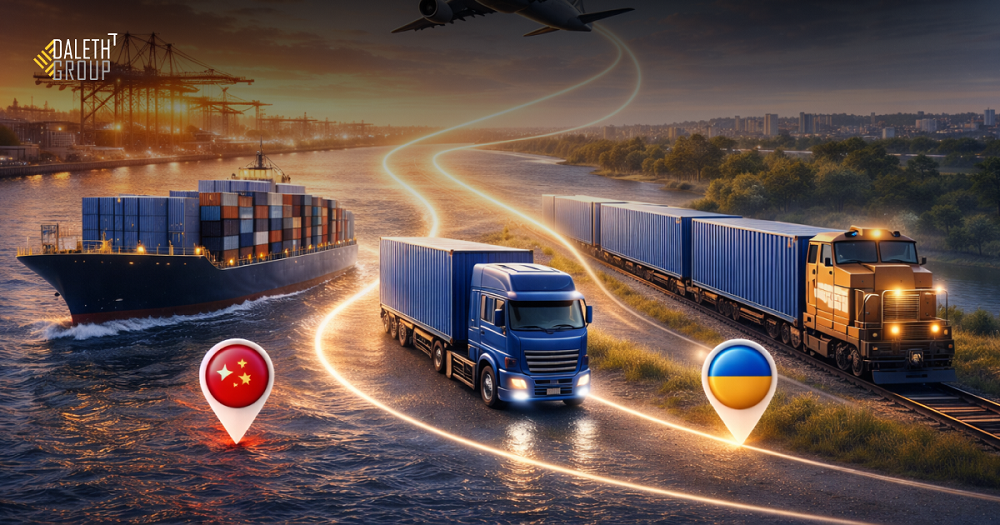
For Ukrainian businesses, China remains a key source of goods from raw materials to finished products. At the same time, not every company operates with volumes that justify a full container shipment. That is why consolidated cargo delivery from China to Ukraine has become a core logistics solution for small and medium-sized businesses.
At Daleth Group, consolidated cargo is not a standalone service but a managed logistics process, where warehouse consolidation, correct transport selection, customs support, and control at every stage play a critical role.
Why Consolidated Cargo Has Become the Standard for Business
Consolidated cargo (LCL) is a transportation format in which shipments from multiple clients are combined into one container or transport unit. Each shipper pays only for their volume or weight, not for the entire container.
For businesses, this means:
- regular shipments from China without freezing working capital;
- reduced financial risks;
- flexibility in managing product range and inventory.
That is why LCL logistics from China is a financially justified and operationally convenient model.
Advantages of Consolidated Cargo Delivery from China to Ukraine
The main advantage of consolidated cargo is the balance between cost and flexibility. A company can:
- import goods more frequently;
- respond to demand faster;
- avoid warehouse overstocking.
Smaller shipments mean lower investments per delivery. With a properly structured logistics process, delivery timelines remain predictable, and costs stay under control.
How Consolidated Cargo Delivery Works: Process Logic
From the outside, it looks simple: cargo is ordered, cargo is delivered.
In reality, consolidated cargo delivery from China is a multi-level process in which warehouse consolidation plays a decisive role.
It is at the warehouse stage that the following are ensured:
- accurate cargo accounting;
- cargo safety;
- realistic delivery timelines;
- elimination of mix-ups and losses.
Consolidation of Consolidated Cargo: The Foundation of Logistics
In LCL logistics, the key factor is not the transport mode itself, but how and at which stage the consolidated shipment is formed. In Daleth Group’s practice, consolidation can take place either at warehouses in China or at ports and logistics hubs in the EU, depending on the client’s objectives.
Consolidation at Warehouses in China
Warehouses in Key Industrial Regions
For consolidated cargo operations, we use a network of consolidation warehouses in China’s major manufacturing hubs: Shenzhen, Guangzhou, Ningbo, and Shanghai. This allows us to receive cargo from multiple suppliers without time-consuming internal relocations.
Cargo Acceptance and Inspection
When cargo arrives at the warehouse, the following checks are carried out:
- verification of the number of packages;
- inspection of packaging integrity;
- photo documentation of the cargo upon the client’s request.
This is the first control point, allowing the cargo condition to be recorded before international transportation begins.
Labeling and Identification
Each cargo unit receives a unique identifier. This approach eliminates the risk of mis-sorting during container deconsolidation in Europe and ensures accurate tracking throughout the entire route.
Formation of a Consolidated Shipment
Cargo from different clients is grouped by type and characteristics:
- general cargo;
- fragile cargo;
- dangerous goods.
This ensures safe co-loading within a single container and minimizes the risk of damage.
Consolidation and Cargo Handling in EU Ports and Logistics Hubs
Given the current logistics environment, consolidated cargo delivery from China to Ukraine often passes through European ports and logistics hubs. The key transshipment points are Poland and Germany.
Container Deconsolidation
A container arriving by sea is promptly:
- unloaded from the vessel;
- transferred to a customs or consolidation warehouse;
- deconsolidated into individual client shipments.
At this stage, the quality of labeling and prior warehouse preparation becomes critically important.
Customs Transit (T1)
For further movement to Ukraine, T1 transit declarations are issued. These allow cargo to be transported through the EU and into Ukraine without financial deposits and with predictable transit times.
Preparation for Final Delivery
After warehouse and customs procedures are completed, the cargo is prepared for the final stage of delivery to Ukraine.
Transport Modes Used in Consolidated Cargo Delivery from China
Sea Transport – The Basis of LCL
Sea freight is the foundation of LCL logistics, as it is at the maritime stage that consolidated containers carrying cargo from multiple clients are transported. This format allows costs to be shared among shipment participants while maintaining controlled delivery costs.
Sea transport ensures schedule stability, supports regular departures, and integrates efficiently with warehouse consolidation in China or EU ports.
Road Delivery
Road transport is used:
- for delivery from European hubs to Ukraine;
- for door-to-door delivery to the client;
- in situations where route flexibility and timeline control are critical.
Road logistics helps avoid unnecessary transshipment and enables precise planning of the final delivery stage.
Air Freight
For urgent or high-value cargo, air freight or combined solutions (air + road) are used.
Air delivery is applied when:
- time is critical;
- the shipment is small but highly valuable;
- rapid market entry is required.
Transit times in this format range from 7 to 14 days.
Transit Times for Consolidated Cargo from China
- sea multimodal delivery – 45–60 days;
- combined solutions – 25–35 days;
- air delivery – 7–14 days.
Customs Clearance and Documentation Support
For import into Ukraine, the following documents are typically required:
- commercial invoice;
- packing list;
- transport documents;
- certificates or permits (if required).
Daleth Group supports clients at all stages of customs clearance, minimizing the risk of delays and additional costs.
Conclusion: How to Ensure Efficient Logistics from China
Consolidated cargo is an effective tool for businesses that want to work with China systematically and predictably. The key factor is not the delivery format itself, but the quality of warehouse organization, consolidation processes, and multimodal routing.
A properly structured warehouse model is what transforms logistics from a challenge into a driver of business growth.
FAQ
What is consolidated cargo from China?
It is a delivery format in which shipments from multiple clients are transported in one container, with payment only for the actual volume or weight.
Where does consolidation take place?
At warehouses in China and at logistics hubs in Europe.
Which transport modes are used?
Sea, road, and air transport, depending on timelines and budget.
Can the cargo be tracked?
Yes, the client receives up-to-date information on cargo status at every stage of delivery.