
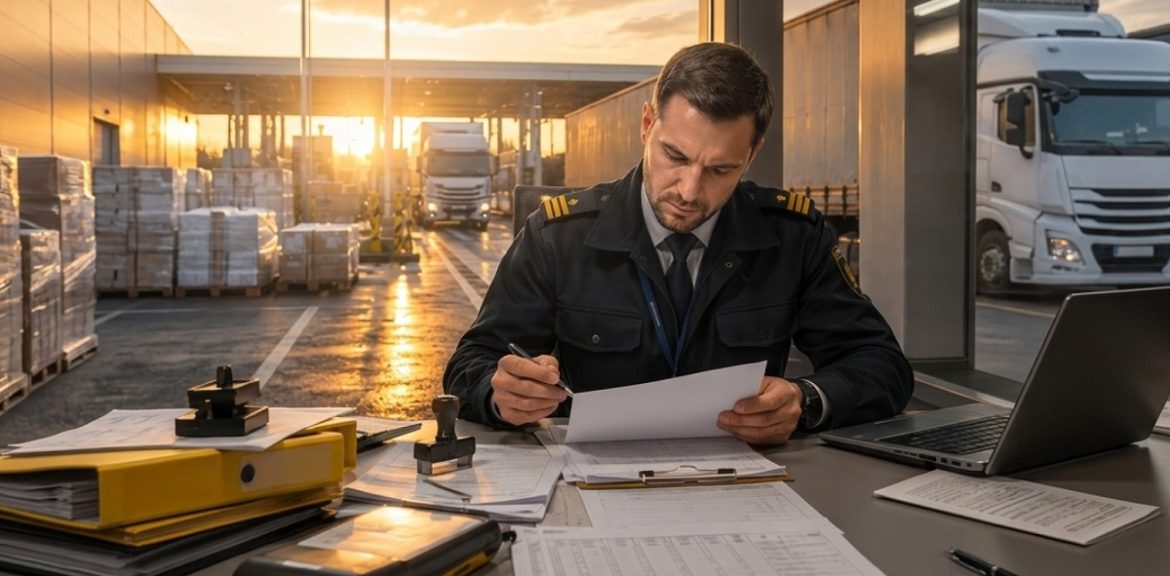
One incorrect HS code, a missing certificate, or a discrepancy in declaration details can hold your cargo at the border for days, or even weeks. That’s the best-case scenario. In the worst case, you’re looking at a fine, confiscation, or criminal liability. Customs clearance mistakes happen even to experienced foreign trade operators, but most of them are typical and entirely predictable. In this article, we’ll break down the five most common mistakes in export and import, explain their consequences, and give practical advice on how to prepare for customs clearance so that your cargo clears customs without delays or unnecessary costs.
Why Customs Clearance Mistakes Are Costly
Customs clearance is a legally significant procedure, and every step is governed by regulatory requirements. The foundation of legal regulation is the Customs Code of Ukraine (Law of Ukraine No. 4495-VI dated 13.03.2012), which defines the procedure for moving goods across the customs border, declaring them, and carrying out customs control and clearance. Certain matters are also regulated by resolutions of the Cabinet of Ministers of Ukraine, orders of the Ministry of Finance of Ukraine, and special legislation depending on the category of goods. In particular, the circulation and import of medicinal products are regulated by the Law of Ukraine “On Medicinal Products,” food safety and state control are governed by the Law of Ukraine “On Basic Principles and Requirements for the Safety and Quality of Food Products,” and international transfers of dual-use goods are regulated by the Law of Ukraine “On State Control over International Transfers of Military and Dual-Use Goods.”
Any inaccuracy in the declaration, documents, or classification of goods entails specific legal consequences, ranging from cargo delays to additional duty and VAT assessments, fines, and customs violation proceedings.
The financial consequences are particularly painful. A truck or container sitting idle at customs generates costs every single day: demurrage, transport downtime, missed delivery deadlines, and penalties owed to buyers. That’s exactly why understanding typical customs clearance mistakes and preventing them is a direct way for any importer or exporter to save money and nerves.
Mistake 1: Incorrect Classification of Goods by HS Code
The HS code is a ten-digit numerical code that uniquely identifies a product within the customs classification system. It determines the duty rate, the list of required permits and certificates, and the control regime. Incorrect classification is one of the most common and most expensive customs clearance mistakes.
How does this mistake happen? The declarant relies on the product name in the invoice or picks a code “by eye” without analyzing the product’s technical characteristics. Or they deliberately choose a code with a lower duty rate, which is a violation of customs legislation.
What are the risks of an incorrect HS code? Incorrect classification of goods by HS code can lead to additional duty, VAT, and other customs payments being assessed if the customs authority determines that a different duty rate or other state regulatory measures should have applied to the goods. Under Articles 69 and 345 of the Customs Code of Ukraine, customs authorities monitor the correctness of goods classification both during customs clearance and after its completion. If violations are found, customs may decide to change the goods classification, assess the appropriate customs payments, and, where grounds exist, initiate proceedings for a customs violation under the Customs Code of Ukraine. If the incorrect classification results from the deliberate submission of false information or other unlawful actions, the declarant may face liability under Ukrainian law.
How to avoid it? Classification should be based on the technical characteristics of the goods, not just their name. For complex or unusual goods, it’s worth requesting a preliminary classification ruling from the customs authority or engaging a customs broker with experience in the relevant product category. Daleth Group’s specialists have practical experience classifying a wide range of goods and help clients avoid this mistake as early as the preparation stage before customs clearance.
Mistake 2: Understating or Incorrectly Determining Customs Value
Customs value is the base for calculating all customs payments, and any deviation from the actual market value of the goods draws close scrutiny from customs authorities. This mistake can be either intentional (an attempt to reduce payments) or unintentional (due to unfamiliarity with valuation rules).
Typical manifestations of the mistake. The declarant states only the invoice price, forgetting to add freight to the border and insurance. Or, conversely, freight is already included in the price under the contract terms, but it gets added again. Another situation: the invoice is issued for one amount, but the actual payment is made for a different amount due to exchange rate adjustments.
Consequences. Customs issues a decision to adjust the customs value under Articles 55-57 of the Customs Code of Ukraine and assesses additional duty and VAT on the difference. Intentional understatement is subject to a fine under Article 472 of the CCU. For systematic understatement, the declarant is added to the list of high-risk foreign trade operators, resulting in enhanced scrutiny at every subsequent clearance.
How to avoid it? Correctly form the customs value base in line with the contract terms and the applicable Incoterms rule, including freight, insurance, and other mandatory elements. Keep payment documents, supplier price lists, and correspondence confirming the terms of the deal. If in doubt about valuation, consult a customs broker before submitting the declaration.
Mistake 3: Incomplete or Incorrect Document Package
Customs clearance is impossible without a complete set of documents. Each document serves its own function: confirming the value of the goods, their origin, the terms of the deal, or eligibility for a preferential duty rate. The absence of even one mandatory document halts the clearance process.
Typical manifestations of the mistake. A missing or incorrectly issued invoice (lacking details, signatures, or a product description). A contract that doesn’t match the terms of the deal stated in the declaration. A missing certificate of origin that would grant a preferential duty rate under a free trade agreement. No insurance policy, or one that doesn’t cover the entire route. Transport documents (CMR, bill of lading) issued to a different consignee.
Consequences. Customs halts clearance and requests additional documents. The time allowed to provide them is limited. If the documents aren’t provided in time, the cargo may be sent back or placed in bonded storage with the corresponding costs charged.
How to avoid it? Build a document checklist in advance, before even ordering the goods. Agree on the document package with the supplier at the contract-signing stage. Separately verify the validity and expiration dates of licenses, permits, and certificates.
“An incomplete document package is the most common cause of cargo delays we see in practice. This is especially true for certificates and permits: a company buys the goods, arranges logistics, and only remembers phytosanitary or veterinary control once the cargo reaches customs. Fixing the situation in real time is both more expensive and more stressful. Prepare your documents in advance — it’s the simplest way to avoid mistakes at customs.”
Maryna Ponomarenko, Head of Daleth Group
Mistake 4: Errors in the Declaration and Its Details
The customs declaration is a legal document, and every field in it matters. Errors in the declaration can be technical (a typo) or systemic (a misunderstanding of the filing rules), but the consequences are the same in both cases: customs halts clearance.
Typical manifestations of the mistake. An incorrectly stated product code, country of origin, or country of dispatch. A discrepancy between the weight stated in the declaration and the actual weight of the cargo. Errors in the sender’s or recipient’s details. An incorrectly stated Incoterms rule, leading to an incorrect calculation of customs value. A mismatch between the product description in the declaration and the invoice.
Consequences. Technical errors are corrected through a declaration adjustment procedure, but this takes time. Systemic errors can lead to inspection, cargo examination, and additional payment assessments. If the error is discovered after the goods have already been released, during post-clearance audit, the consequences are even more serious.
How to avoid it? Check all declaration details before submission. Cross-check the declaration data against the invoice, contract, and transport documents. Use software for automatic field-matching verification. For complex clearances, engage a customs broker who bears responsibility for the accuracy of the declaration.
Mistake 5: Ignoring Permits, Certificates, and Licenses
Certain categories of goods require mandatory permits, certificates, or licenses for import or export. Ignoring this requirement is a critical mistake that can completely block the cargo at customs.
Typical examples. Food products and beverages must undergo non-tariff food control, which requires providing a Health Certificate or a quality certificate specifying the product’s composition, under the Law of Ukraine “On State Control of Compliance with Legislation on Food Products, Feed, and By-products of Animal Origin” No. 2042-VIII. Livestock products require a veterinary certificate under the Law of Ukraine “On Veterinary Medicine” No. 2498-XII. Chemical products, plant protection agents, or medicines require special permits from regulatory bodies. Dual-use goods (usable for both civilian and military purposes) require an export license under the Law of Ukraine “On State Control over International Transfers of Military and Dual-Use Goods” No. 549-IV.
Consequences. Without the required document, customs control cannot release the cargo. If a certificate or permit cannot be obtained (for example, if non-compliance with standards is found), the goods are subject to return or destruction. For customs clearance of international technical assistance, the list of required documents is particularly specific and requires separate preparation.
How to avoid it? Before ordering the goods, check whether they are subject to mandatory certification or licensing in Ukraine. Ask a customs broker or a foreign trade lawyer for the current list of requirements for the specific type of product. Initiate the process of obtaining the necessary documents in advance, since some of them take weeks to issue.
Consequences of Mistakes: Fines, Delays, Additional Inspections
The consequences of customs clearance mistakes fall into three categories: financial, operational, and reputational. Understanding their scale is an additional incentive for careful preparation.
| Type of Mistake | Possible Consequences | Risk Level |
| Incorrect HS code | Additional payment assessment, 100–300% fine | High |
| Understated customs value | Adjustment, additional assessment, fine | High |
| Incomplete document package | Cargo delay, additional inspections | Medium |
| Errors in declaration details | Clearance halted, cargo inspection | Medium |
| Missing permits and certificates | Cargo blocked, return or destruction | Critical |
| Understated quantity or weight | Fine, confiscation of excess | High |
| Late submission of declaration | Financial penalties, late fees | Medium |
The Role of a Customs Broker in Preventing Mistakes
A customs broker is a qualified specialist who acts on behalf of the declarant and bears responsibility for the correctness of customs clearance. Engaging one is the most effective way to avoid fines at customs and ensure the smooth passage of cargo.
A customs broker performs functions that are hard to carry out without deep knowledge of international trade and the customs legislation of Ukraine and other countries, as they correctly classify goods by HS code, correctly determine (calculate) the customs value of imported goods, verify document completeness, fill out the declaration without technical errors, and monitor compliance with all regulatory requirements.
The Daleth Group customs brokerage services team supports import and export customs clearance across various customs regimes and has experience working with different categories of goods. This allows our clients to focus on their business rather than on customs procedures.
Customs Clearance Preparation Checklist
The simplest way to prepare for customs clearance is a systematic checklist covering all the key aspects.
Documents:
- an invoice with complete details, a description, and the value of the goods;
- a contract with the supplier that complies with international standards;
- payment documents confirming payment;
- transport documents (CMR, bill of lading, air waybill);
- an insurance policy for the cargo;
- a packing list stating gross/net weight and quantity;
- certificates of origin (EUR.1, Form A), if applicable.
Classification and value:
- verify the correct HS code for each line item;
- calculate the customs value including freight and insurance;
- make sure the value matches the market level.
Permits and certificates:
- check whether the goods require phytosanitary, veterinary, or food control;
- confirm you have the necessary import or export licenses (if applicable);
- check that permits are current and haven’t expired.
Declaration:
- cross-check all declaration details against the documents;
- verify that the product description matches between the declaration and the invoice;
- make sure the stated Incoterms rule is correct.
Conclusion
Customs clearance mistakes aren’t rare occurrences, they’re a systemic problem that most foreign trade operators face at least once. Most of them are predictable and easy to eliminate with proper preparation. The correct HS code, an accurate customs value, a complete document package, and permits obtained on time are the four pillars of successful customs clearance. If you want to be confident that your cargo will clear customs without delays or extra costs, reach out to Daleth Group. Our customs brokers support clearance from document preparation all the way through to the release of goods into free circulation.
FAQ
What are the most common customs clearance mistakes?
The most common customs clearance mistakes are: an incorrect HS code, understated customs value, an incomplete document package, errors in declaration details, and missing mandatory permits and certificates. Each of these mistakes can lead to cargo delays, additional payment assessments, or fines.
What are the risks of an incorrect HS code?
An incorrect HS code leads to additional duty and VAT being assessed at the correct rate, a fine ranging from 100% to 300% of the underpaid amount, and delays to the cargo at customs. In cases of deliberate rate reduction through false classification, criminal liability is possible.
How can you avoid cargo delays at customs?
To avoid delays, you need to prepare a complete document package in advance, correctly classify the goods and determine the customs value, verify that all required permits and certificates are in place, and engage an experienced customs broker. Most delays occur due to missing or incorrect documents.
Do you need a customs broker for clearance?
Technically, a declarant can submit a declaration independently, but without deep knowledge of customs legislation, the risk of customs clearance mistakes is very high. A customs broker is experienced and bears responsibility for the correctness of the clearance, making it the most reliable way to avoid fines at customs.
What happens for understating customs value?
For understating customs value, customs assesses additional duty and VAT on the difference between the declared and adjusted value, and imposes a fine. In cases of systematic or deliberate understatement, the declarant is added to the high-risk list, resulting in enhanced scrutiny at every subsequent clearance. For significant amounts, criminal liability is possible.