
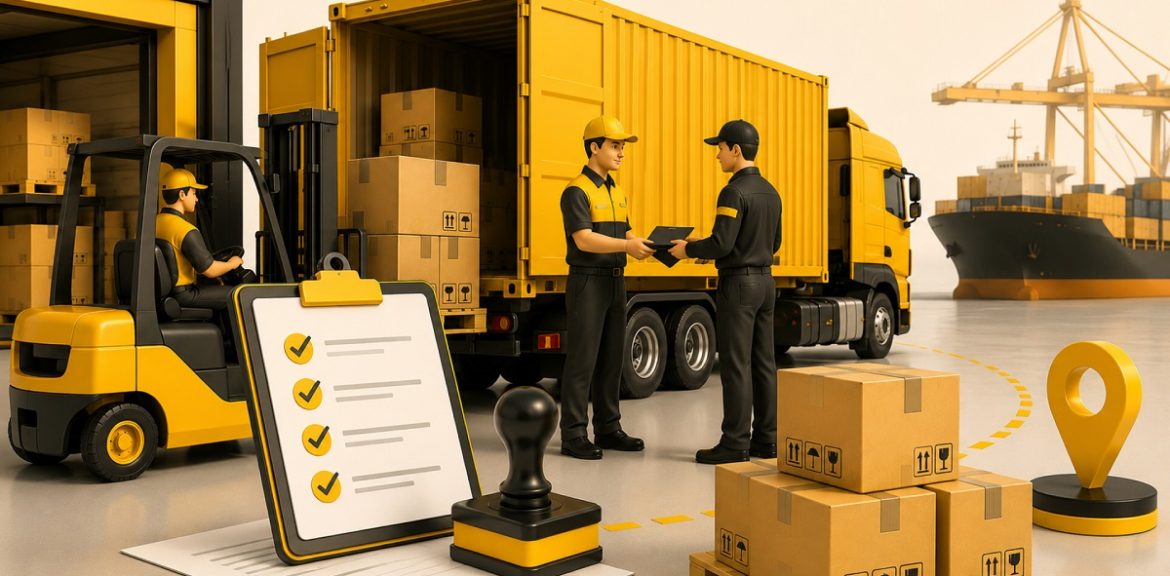
FCA (Free Carrier) delivery terms solve one of the most common problems in international trade: how to hand over goods to the buyer so that both parties clearly understand their obligations. This FCA basis is actively used by importers and exporters who work with different modes of transport and want to avoid legal uncertainty when transferring cargo. The application of Incoterms in Ukraine is based on the Commercial Code of Ukraine (Part 4, Article 265) and the Law of Ukraine “On Foreign Economic Activity,” so the parties independently fix the required edition of the rules in the contract text. In this article, we look at exactly how FCA delivery terms work, where the transfer of goods takes place, who handles customs clearance, and when the risks pass.
What Are FCA Delivery Terms
What FCA means in international trade: it is a delivery basis under which the seller hands over the goods to a carrier or another person named by the buyer at a specified place. The seller is obliged to complete export customs clearance before the goods are handed over. This is exactly what distinguishes FCA terms from EXW (Ex Works), where customs clearance is the buyer’s responsibility.
FCA delivery terms are suitable for any mode of transport: road, rail, sea, air, and multimodal. This makes FCA delivery a universal tool for most foreign economic deals, regardless of the route and type of cargo.
Decoding the Term Free Carrier in Incoterms
FCA (Free Carrier) Incoterms 2020, meaning “free carrier,” means that the seller has fulfilled its delivery obligations the moment the goods are handed over to the buyer’s carrier at the agreed place.
FCA Incoterms belongs to group F, together with the FAS and FOB bases. The bases in this group share one feature: the buyer organizes and pays for the main international transportation.
Incoterms as a whole is a system of 11 trade terms developed by the International Chamber of Commerce and divided into four groups: E, F, C, and D, depending on the scope of the seller’s obligations. The current edition, Incoterms 2020, defines for each basis the moment of risk transfer, the distribution of costs, and the parties’ obligations regarding documents and customs clearance. When placing an order and signing a foreign economic contract, it is important to specify not just the name of the basis but the exact edition of the rules, for example “FCA Incoterms 2020,” and the precise place of transfer of the goods: without these two elements, the basis loses legal clarity and becomes a subject of disputes. The choice of basis also directly affects the contract price, since it determines whether the cost of the goods includes logistics, insurance, and customs charges, or whether the buyer pays for them separately.
The seller is only responsible for delivering the goods to the place of transfer to the carrier and for export customs clearance. The Incoterms 2020 edition clarified an important nuance: if the place of transfer is the seller’s premises, loading onto the buyer’s vehicle is performed by the seller. At any other place, the goods are considered transferred as soon as they are unloaded from the seller’s vehicle at the agreed point.
Two Options for Transferring the Goods: at the Seller’s Warehouse and at Another Place
The FCA basis provides for two scenarios for transferring the goods, and the choice between them significantly affects the distribution of costs and risks.
Option 1: transfer at the seller’s warehouse or premises. The seller loads the goods onto the vehicle provided by the buyer or the buyer’s carrier. Risks pass after loading. This option is convenient when the buyer arranges pickup of the goods directly from the seller.
Option 2: transfer at another agreed place (customs terminal, freight forwarder’s bonded warehouse, railway station, port). The seller delivers the goods to this place using its own transport or transport it has pre-booked for delivery to the destination country (there will be no transshipment to another vehicle here). The goods are considered transferred the moment they are ready for unloading from the seller’s vehicle. Risks pass to the buyer exactly at this moment.
The choice of option is fixed in the contract with the exact address of the place of transfer specified. A vague wording without a specific address is a common mistake that leads to disputes between the parties.
Seller’s Obligations Under FCA Terms
Under FCA terms, the seller bears a clearly defined list of obligations:
- prepare the goods, pack, and label them in accordance with the terms of the contract;
- file the export customs declaration and the EUR.1 certificate, and pay the relevant fees in the country of dispatch;
- deliver the goods to the agreed place of transfer to the buyer’s carrier;
- load the goods, if the place of transfer is the seller’s premises;
- provide the buyer with all necessary documents: invoice, packing list, certificates, customs documents.
The seller is not responsible for organizing international transportation, cargo insurance, or customs clearance in the buyer’s country. These obligations pass entirely to the buyer after the goods are handed over to the carrier.
Buyer’s Obligations Under FCA Terms
Under FCA delivery, the buyer takes on responsibility for the entire chain after the goods are transferred:
- appoint a carrier and inform the seller of its details and the place of transfer;
- organize and pay for international transportation from the place of transfer to the final destination;
- insure the cargo (at their own discretion);
- file the import customs declaration in their own country and pay the relevant customs charges;
- accept the goods at the specified place and at the agreed time.
If the buyer does not show up on time or does not appoint a carrier, responsibility for the risks may pass to them earlier than provided for in the contract. This point should be specified separately in the text of the agreement.
“FCA is one of the most practical bases for working with Ukrainian importers and exporters. The seller completes its task after handling the export and handing the goods over to the carrier, while the buyer gets a clear starting point for their responsibility. This significantly reduces the number of conflict situations compared to EXW, where customs clearance issues often become a subject of disputes.” — Daleth Group specialist
The Moment of Transfer of Risks and Responsibility
The moment of risk transfer under FCA delivery terms depends on the chosen place of transfer. If the transfer takes place at the seller’s warehouse, risks pass after loading onto the buyer’s vehicle. If the transfer takes place at another location, risks pass the moment the goods are ready for unloading at the agreed point.
From the moment the risks transfer, the buyer bears full responsibility for the safety of the cargo. Any damage, loss, or delay during international transportation is the buyer’s risk. That is why cargo insurance, although not mandatory under FCA, is in practice a necessary step to protect the buyer’s interests.
Distribution of Costs and Customs Clearance
FCA Incoterms 2020 clearly divides costs between the parties. The seller pays for preparing the goods, export customs clearance, and delivery to the place of transfer. The buyer takes on all costs after that moment.
Zone of Responsibility
| Zone of Responsibility | Seller (FCA) | Buyer (FCA) |
| Preparation and packaging of goods | Yes | No |
| Loading (if transfer at the seller’s warehouse) | Yes | No |
| Export customs clearance | Yes | No |
| International transportation | No | Yes |
| Cargo insurance | No | Yes (if needed) |
| Import customs clearance | No | Yes |
| Payment of import customs charges | No | Yes |
| Risks after transfer to the carrier | No | Yes |
Regarding customs clearance: the seller is obliged to file the export customs declaration in its own country. This is a fundamental difference from EXW, where the buyer handles export clearance in a foreign country. Under FCA, the buyer is only responsible for import customs clearance in their own country. The Daleth Group team provides full customs clearance support when working with any Incoterms basis, both in Ukraine and in Europe.
Advantages and Disadvantages of FCA for the Parties
Advantages for the seller: a clearly limited scope of obligations, no need to organize international transportation, and a clear moment of risk transfer. The seller has fulfilled its obligations as soon as it hands the goods over to the carrier with export clearance completed.
Disadvantages for the seller: the need to handle export customs clearance, which requires appropriate resources and knowledge. For small manufacturers without experience in foreign economic activity, this can be an extra burden.
Advantages for the buyer: no need to deal with customs clearance in the seller’s country, which removes the main drawback of EXW. The buyer appoints their own carrier and controls the route and the cost of international logistics.
Disadvantages for the buyer: full responsibility for the safety of the cargo during international transportation, and the need to appoint a carrier in a timely manner and notify the seller. A delay in appointing a carrier can lead to additional storage costs at a warehouse or terminal.
Common Mistakes When Using FCA
The first and most common mistake: an unclear definition of the place of transfer of the goods in the contract. The phrase “transfer at the terminal” without a specific address and the name of the terminal operator is grounds for disputes. The contract should always specify the exact address, the name of the facility, and the terms of access.
The second mistake: the buyer does not appoint a carrier on time or does not inform the seller of the carrier’s details and arrival time. In this case, responsibility for the risks may pass to the buyer earlier than the actual transfer of the goods takes place.
The third mistake: confusion between FCA and FOB in sea transportation. For containerized cargo, Incoterms recommends using FCA rather than FOB. Under FOB, risks pass the moment the goods are loaded on board the vessel, but in reality, the container is handed over to the carrier much earlier, at the terminal. This creates a gap in responsibility that does not exist under FCA. For multimodal transportation, FCA is the optimal choice precisely because of the clear moment of transfer at the terminal or warehouse.
The fourth mistake: lack of insurance. Although FCA does not require either party to insure the cargo, the absence of an insurance policy on the buyer’s side means the full acceptance of financial risks during international transportation.
Conclusion
FCA delivery terms are one of the most balanced and practical bases in the Incoterms system. The seller performs its main task: preparing the goods, handling the export, and handing them over to the carrier. The buyer gets clear control over logistics without having to navigate the customs procedures of a foreign country. But even under FCA, companies often lack the resources to go through the whole process on their own: finding a reliable carrier, correctly issuing the certificate of origin, calculating the delivery cost with all charges included, or arranging financing for the purchase. The Daleth Group team takes on this entire process turnkey: selecting a carrier and preparing export documents, delivery and financing of shipments, resolving prepayment issues and working with banks, including through companies in the EU that can act as agents and guarantors of the purchase, as well as full cargo support from customs clearance to final delivery. All these services are available in one office, so reach out for a consultation before concluding a foreign economic deal.
FAQ
What is Incoterms and why is it needed?
Incoterms is a set of 11 international trade terms developed by the International Chamber of Commerce for the uniform interpretation of delivery terms in different countries. Each term determines which party to the deal is responsible for transportation, customs clearance, insurance, and the moment of risk transfer. Using Incoterms helps avoid disputes between the seller and the buyer and clearly fixes the parties’ obligations in the foreign economic contract.
What does the FCA delivery term mean?
FCA (Free Carrier) means that the seller hands over the goods to a carrier or another person named by the buyer at an agreed place after completing export customs clearance. From that moment, all risks and costs pass to the buyer. This is one of the most universal Incoterms bases, suitable for any mode of transport.
Who is responsible for customs clearance under FCA?
Under FCA terms, the seller handles export customs clearance in its own country. The buyer arranges import customs clearance in their own country and pays the relevant charges. This is a fundamental difference from EXW, where the buyer independently handles customs clearance in the seller’s country.
At what moment do the risks pass under FCA?
If the place of transfer is the seller’s warehouse or premises, risks pass after the goods are loaded onto the buyer’s vehicle. If the transfer takes place elsewhere (terminal, railway station), risks pass the moment the goods are ready for unloading at that point. The exact moment depends on the terms of the contract.
How does FCA differ from EXW and FOB?
FCA differs from EXW in that the seller handles export customs clearance itself. It differs from FOB (Free On Board) in the moment risks transfer: under FOB, risks pass when the goods are loaded on board the vessel, while under FCA, the transfer happens earlier, at the carrier’s terminal or warehouse. For containerized shipments, Incoterms recommends FCA rather than FOB.
Where does the transfer of goods take place under FCA?
Under the FCA basis, the transfer of goods takes place either at the seller’s warehouse or at another agreed place: a terminal, railway station, forwarder’s warehouse, or airport. The specific location is fixed in the contract with the exact address specified. The choice of location determines who performs the loading and at what moment the risks pas