
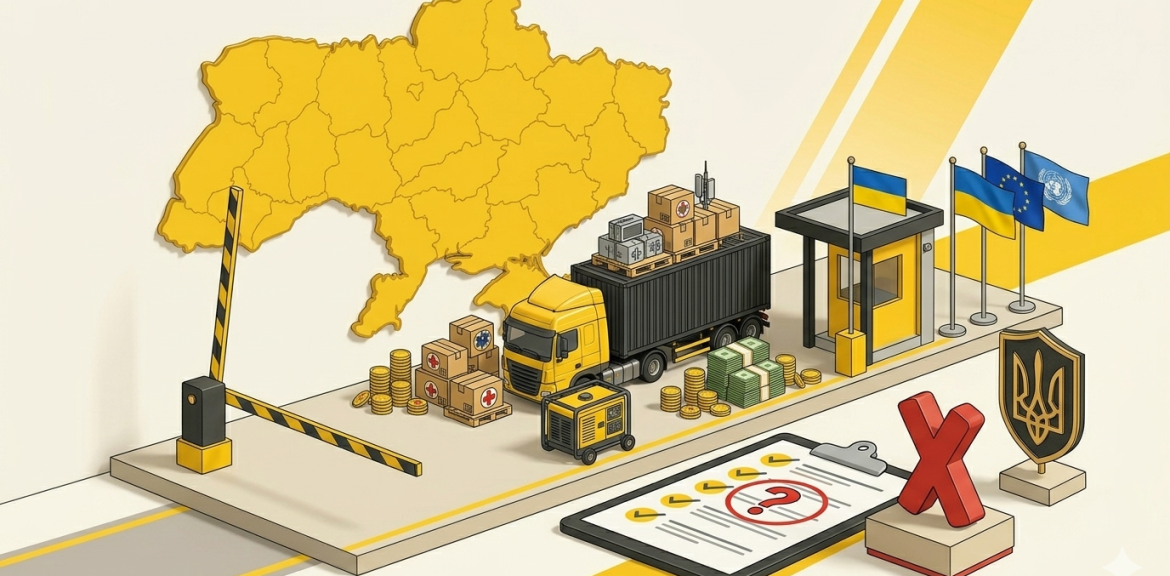
Customs clearance of international technical assistance is not a formality. It is a procedure where every figure in a declaration, every line in an invoice, and every document translation carries legal weight. If ITA documents contain even a minor inaccuracy, customs will block the shipment. What follows is penalties, transport downtime, missed donor programme deadlines, and the risk of losing exemptions. Daleth Group manages customs clearance of international technical assistance from the initial document review through to cargo handover at the recipient’s warehouse.
What is international technical assistance
ITA refers to goods, equipment, or services delivered to Ukraine by foreign donors free of charge under officially registered projects. The legal basis is CMU Resolution No. 153 dated 15.02.2002. Unlike commercial imports, ITA provides exemption from import duty and VAT, but only when all document requirements are met precisely and the cargo matches the terms of the agreement.
The key point: exemptions are not granted automatically. Customs checks every line in the declaration against the donor agreement and the CMU decision. If there are discrepancies — even technical ones — the shipment is stopped. This is why errors in customs documents for ITA shipments cost more than mistakes in any other type of import.
What documents are required for customs clearance of international technical assistance
Before cargo crosses the border, customs requires a complete document package. A single missing document is grounds for delay or refusal of release. ITA documents cover a standard and extended list depending on the cargo type.
Standard document package:
| Document | Requirements |
| Grant agreement | With a notarised Ukrainian translation |
| CMU decision | On project registration, with a valid effective date |
| Invoice or specification | From the donor, marked as a grant or free-of-charge supply |
| Packing list | With a precise list and weight for each line item |
| Transport documents | CMR for road transport, airway bill or bill of lading |
| Technical documentation | Manuals, certificates, equipment passports |
Medical equipment additionally requires Ministry of Health permits. Radio electronics require an NCEC conclusion. Vehicles require a conformity certificate and further permits from the relevant authorities. The absence of these documents means a mandatory customs stop.
Why a document error in ITA clearance can lead to major financial losses
The financial consequences of errors in customs clearance of international technical assistance fall into two categories: direct and indirect. Direct costs include penalties, storage charges, and re-declaration fees. Indirect costs include missed donor programme milestones, reputational damage for the recipient and implementer, and potential cancellation of exemptions across the entire project.
Direct financial risks:
| Risk type | Possible consequences |
| Nomenclature error | Exemption denied, full duty and VAT assessed on the entire shipment |
| Incorrect recipient | Cargo held, re-declaration required |
| Expired permit | Import prohibition, cargo returned |
| Incorrect invoice | Reclassified as commercial import with full taxation |
| Missing translation | Delay of 3 to 10 business days |
A separate risk is late CMU project registration. If cargo arrives at customs before the project has received official status, exemptions do not apply — even when all other documents are in order. The shipment is either held until registration is complete or cleared as a standard commercial import with full duties.
What mistakes are most common in ITA customs clearance
Errors in ITA customs clearance follow several recurring patterns. Below are the most common ones, regularly encountered by customs brokers in practice.
Cargo departed before CMU registration was completed. The organisation received confirmation from the donor and coordinated dispatch without verifying the registration status. Cargo arrives at the border — and the CMU decision has not yet taken effect. The result: storage costs until registration is finalised (a week or more), or clearance without exemptions.
Invoice nomenclature does not match the agreement. The donor issued an invoice with a generic description — for example, “medical equipment” instead of the specific name and code. Customs compares each line against the agreement. If the description does not match, the exemption is denied for that line.
The recipient is incorrectly stated in the documents. For ITA purposes, the recipient in the customs sense must be an accredited beneficiary — a state institution or NGO. If the transport documents name the implementer or subcontractor instead, customs will refuse to apply exemptions.
The invoice was issued on commercial terms. Even if the supply is genuinely free of charge, an invoice showing any payment terms (net 30, EXW, etc.) signals a commercial transaction to customs. The document must be reissued with a clear statement: “Grant supply / Free of charge”.
Translations are missing or prepared by a non-accredited translator. Customs accepts only official translations. Without notarial certification, the document is disregarded.
A consultation on ITA customs clearance at an early stage allows all of these scenarios to be avoided before the shipment departs.
Who is responsible for the accuracy of ITA documents
Legal responsibility for the ITA customs declaration rests with the declarant — the individual or company submitting the declaration. In practice this is either the recipient directly or an accredited customs broker acting under a power of attorney.
Responsibility breakdown:
| Party | Area of responsibility |
| Donor | Accuracy of invoice, specification, and packing list |
| Recipient | CMU project registration, obtaining required permits |
| Customs broker | Declaration preparation, document compliance check, submission |
| Logistics company | Transport documents, route planning, delivery timelines |
If the donor makes an error in the invoice and the customs broker did not review the documents before dispatch, the recipient effectively bears the consequences. This is why ITA customs clearance services from an experienced broker must include a mandatory review of the entire document package on the sender’s side.
Daleth Group carries out a pre-shipment document audit before cargo is dispatched. We verify nomenclature compliance, recipient accuracy, project registration status, and the presence of all required permits. As a result, most issues are resolved before cargo reaches the border.
Can customs hold a shipment due to document inaccuracies
Yes, and it happens regularly. Customs has the right to stop a shipment for additional inspection or refuse release if documents fail to meet requirements. Grounds for a hold may be technical (wrong commodity code, incorrect document date) or substantive (description does not match the agreement).
Typical delay scenarios:
| Grounds | Average resolution time |
| Nomenclature discrepancy | 5–15 business days |
| Missing or incorrect translation | 3–7 business days |
| Missing permit for specific cargo | 10–30 business days |
| Cargo arrived before CMU registration | Until registration is complete |
| Incorrect recipient stated | 7–20 business days |
While held, cargo sits in a bonded warehouse — accumulating daily storage charges. Add legal costs for resolving the situation, a possible re-inspection, and document re-preparation. The total cost of a serious error can reach tens of thousands of dollars.
To avoid this, organisations that regularly receive ITA shipments engage a customs broker at the document preparation stage, not after cargo has arrived at the border. Customs brokerage services from Daleth Group cover the entire cycle — from donor document review to cargo release to the recipient.
How to reduce risks in ITA customs clearance
The practical risk mitigation process follows four steps in strict order.
Step one: verify CMU project registration status before coordinating dispatch. Cargo must not depart while the CMU decision has not yet taken effect. This is the fundamental rule that is broken most often.
Step two: align the invoice with the donor before dispatch. Every line in the invoice must precisely match the wording of the agreement and the CMU decision. If the donor uses internal codes, a specification cross-referenced to the agreement is required.
Step three: identify whether additional permits are needed. The list of required permits varies by cargo type. For some categories, obtaining a permit takes two to six weeks — this time must be factored into planning.
Step four: engage an accredited customs broker for preparation of the ITA customs declaration. The broker checks the completeness of the package, document compliance, and the grounds for applying exemptions before the declaration is submitted.
International freight services and ITA customs clearance are two interconnected processes. If logistics are planned without accounting for document preparation timelines, even a correctly prepared shipment can arrive at the border at the wrong moment.
Daleth Group ITA clearance services
Daleth Group provides ITA customs clearance services with accreditation at the Kyiv, Volyn, Lviv, Odesa, and Ternopil customs offices. The company has hands-on experience with donor programmes run by international organisations, foundations, and government agencies.
What is included in full-service support:
| Service | What it covers |
| Document audit | Package review before cargo is dispatched |
| Declaration preparation | Completed with ITA status and exemption grounds stated |
| Electronic submission via EDIAS | E-declaration filing, prompt responses to inspector queries |
| Inspection coordination | Representative present at customs |
| Logistics support | Route planning, transport, last-mile delivery to recipient |
For complex routes with multiple transhipment points, we arrange multimodal transport with unified document management. A consultation on ITA customs clearance is available on the day of enquiry.
FAQ
What is international technical assistance?
ITA refers to goods, equipment, or services delivered to Ukraine by foreign donors free of charge under projects registered with the CMU in accordance with Resolution No. 153 dated 15.02.2002. ITA imports are exempt from duty and VAT when documents are properly prepared.
What documents are required for customs clearance of international technical assistance?
Core package: grant agreement with translation, CMU project registration decision, donor invoice or specification, packing list, transport documents, technical documentation. Additional permits are required for medical equipment, radio electronics, and vehicles.
Why can a document error in ITA clearance lead to major financial losses?
Errors in customs documents block the application of exemptions and result in duty and VAT assessments across the entire shipment, penalties for inaccurate declaration, storage and re-declaration costs. In serious cases the total amount can reach tens of thousands of dollars.
What mistakes are most common in ITA customs clearance?
The most frequent errors in ITA customs clearance: cargo dispatched before CMU project registration, invoice nomenclature does not match the agreement, recipient incorrectly stated, invoice issued on commercial terms, official document translations missing.
Who is responsible for the accuracy of documents when importing international technical assistance?
Legal responsibility rests with the declarant — the recipient or an accredited customs broker. The donor is responsible for the accuracy of the invoice and specification, the recipient for project registration and permits, the customs broker for preparation and submission of the ITA customs declaration.
Can customs hold a shipment due to document inaccuracies?
Yes. Customs has the right to stop a shipment for additional inspection or refuse release when documents do not comply with requirements. The length of the delay depends on the nature of the error and can range from a few days to several weeks.